Saturday, January 9, 2016

Benched Week 93: what time will tell


Time is a curious thing. It’s so changeable. Sometimes the clicks of the clock are like ants marching in a long line. Then suddenly, a moment will soar skyward, giving us a dizzying bird’s-eye glimpse of the span of our lives.

This happens often when I read my old journals. Present Me coexists in the same instant with Younger (and often Clueless) Me. But this also happens when I reconnect with long-lost friends – something I’ve been doing a lot lately.


Here I am with my long-lost childhood friend, Paul. He’s just one of a half-dozen of old friends who have recently stepped out of the past with a warm embrace. Each one has handed to me precious reminders of who I was. And perhaps, still am.


Which brings me to my bench. With a suitable compression of time, I return to the photos I took a month ago in a park outside of Washington, D.C. where I discovered two interesting visuals -- metaphors of the past.


On one modern bench lay a wilting bouquet of roses. It was startling to see such luxurious red in a drab landscape.

And nearby, another bench…


…gave me a view of the stone foundations of a farmhouse.


This is the time of year when I take time to reflect on recent history. I love that we have a reset button in our calendar, when we all give ourselves fresh starts. As I use my bird’s-eye view of the past year, my hope is to celebrate those glorious, yet fleeting, moments and successes – the memories of which fade like the bloom of roses. And to find those rock-solid lessons on which I can build.


That’s the challenge. Cherish the good of the past. But never stop building. Keep creating. Constantly grow.

Celebration and anticipation. Looking back and looking ahead.

For me, for now, the best vehicle for that dual perspective is the visual journal I’ve been keeping for the past year. In some ways, it is the outlet for my personal creativity I’ve searched for on all these benches.


For though it slowly fills with memories, every day starts the same way: with an invitingly blank page. And like the time remaining for each of us, blank isn’t simply the absence of content.
It’s the presence of unlimited possibility.
Time to get started!


Friday, December 11, 2015

Benched Week 92: sneaking up on me


‘Tis the season of surprises. If you think about it, it’s a main ingredient for the way we’ve cooked up our cultural take on Christmas. There’s the surprise of opening presents. The surprise of Santa’s stealth run. And for parents our age, there’s the surprise of seeing which kids come home for the holidays. (Think Folger’s “Peter!”)


But I haven’t had time for the unexpected. With a travel schedule that is allowing me one full day at home for the first three weeks of December, I have been doing my best to eliminate anything unpredictable. I have enough trouble trying to figure out if I am sinking or swimming as I try to keep up.


Then, this morning, preparing to leave my hotel in Sugar Land, Texas, I had a few minutes before catching an Uber, so I wandered into the “town square” of this a-bit-too-cute, designed community.


And just like a playful elf, the unexpected sneaked up and startled me. Just to see if it could draw out a smile.

First was the unlikely sight of fall colors in December.
 

Then, there was the magic trick of a floating present.


Saving the best for last old elf himself appeared before me. On a bench.
And that did make me laugh.


Delight is such a precious commodity. None of us can get enough of it. Delight is the by-product of surprise, when that which sneaks up on us is right or true or pure or lovely. Like my encounter, earlier this week with the son of one of the participants in our event. I stretched out on the ballroom floor to draw for him. Tomas sat down next to me. (He was surprised and amused by my bald pate. His mortified parents apologized profusely.) But I was the one delighted – by the sweetness of a little child. 

Isn’t that, after all, what makes this season so wonderfully surprising? Not that tired truism that “Christmas is for children.” But that Christmas is about that one Child. The most unexpected gift of all.


With delight waiting in the wings.

Saturday, October 31, 2015

Benched Week 91: our heads in the cloud


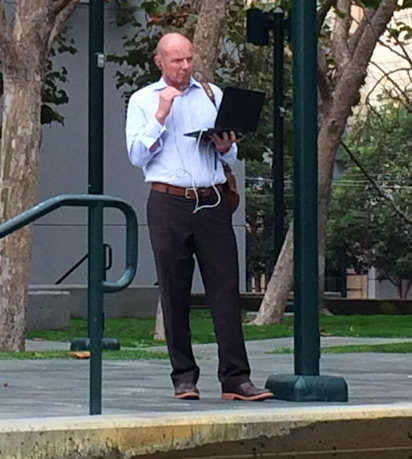
During the day, in any given city, I can find a bench with a respectable amount of solitude. Not this week in San Francisco. There’s a huge, city-wide convention going on. Arriving at the Yerba Buena Gardens, I felt like a party crasher.

The convention is all about the cloud. It’s a concept that dominates the events I scribe – transferring our data to a remote and seemingly limitless repository.


But as I watched the people around me, I couldn’t help but wonder if we’ve transferred more than just our data. All around me, people seemed buried in their phones or laptops.


Griping about people on their phones, though, is pointless. It’s our new reality. I run the risk of looking as stodgy as this church does next to its sleek corporate neighbors.
 
 
But a funny thing happened as I sat and watched. After a while, up through the babble of tech conversations, other sounds emerged.

The laughter of a young mom.


A rake in the grass.
The enthusiastic greeting of a man to a dog.
A bird behind me, feeding on seeds.


And the one word that was said to me, spoken by the groundskeeper in the hat who passed me when I picked up my paper that had blown to the ground: “Thanks.”
 
They were all little vignettes of everyday life. Anchored in the real world.


In a strange way, art is like the cloud. A painting represents a world of information accessible through a small interface. But rather than being just a storage of content, retrievable when we need it, art calls us to engage that world. And be changed by it.
Another park pressed with people!

I read recently a comment by Semir Zeki, a researcher in neuroaesthetics – a relatively new field of study of the effect of art on the brain. He observed, “The blood flow increased for a beautiful painting just as it increases when you look at someone you love.” Art challenges us to engage. It connects us with our common experiences.
 
It grounds us. 
 
Though it does require slowing down to engage with it, art helps us keep our eyes and hearts open to the world around us.
 
Even if our future looks very cloudy.

Sunday, October 25, 2015

Benched Week 90: and no cats were harmed


What are you curious about? 

On my way down to Drexel University this week in Philadelphia, I listened to a podcast of an interview with a successful author and entrepreneur. At one point he said that his earliest memory was one of being curious. He then said, “Curiosity is the essence of someone who solves problems.”


So I decided to give myself a problem while looking for a bench: what could I wonder about as I wandered?


Some things were easy. It’s hard not to be drawn by a large dragon sculpture -- and to mull over why it was there. (That answer came easily. Marco the Magnificent is the school mascot. And he’s everywhere.)


A dramatic fire escape made me consider if it was planned when the ornate building was constructed or added later.


But other ponderings called for more observation. What was this young woman studying so intently?


How could such a smartly-dressed man be so stupid as to smoke?


What brought these two women into the world of coeds?


Why is that one window different?


And who in their right mind would order anything from a truck with a cow like this on it?


All this questioning reminded me of something Denise Shekerjian, author of Uncommon Genius, wrote: “Noticing has a cousin: curiosity.” The latter flows out of the former. If one sits down long enough to notice the world around, questions naturally arise.
True inquisitiveness goes deeper. Honestly, none of these questions matter to me enough to find an answer. But even idle speculation has a purpose. It can lead to creating. If noticing asks “What is it?” and curiosity, “Why is it?” then creativity adds “What can it become?” The cigarette above might become a visual metaphor for rebellion in a painting. Or the start of a new genre of campus film noir.
So, in my search to rediscover my personal art, perhaps it’s as simple as seeing it as a quest for questions.
Now, isn’t that a curious thing?


Wednesday, October 14, 2015

Benched Week 89: thinking inside the box


I had been scribing for only a short time in my event this week when a familiar phrase popped up. “We need to think outside the box,” a participant reminded the large crowd. A little later, someone else suggested getting rid of the box altogether. Still later, another challenged everyone to “stand on the box!”

All the while, I was intently fixated on staying inside mine.


For this event, I had given myself the challenge of capturing content in “justified” columns – where all the lines ended at the same length, creating rectangles of words. Like articles in a newspaper.
It relied on intuition. I had to guess how large to make the initial letter of each line so that the words wouldn’t exceed my lightly ruled pencil box at the end. I didn’t do it perfectly, but close enough to make me happy.

Though there was no reason to add an extra layer of difficulty, I suppose I wanted to flex my typographical muscles a bit. Which is why, when I went looking for a bench in the expansive atrium of the resort later, I had to choose the one under the screen that called me out.


I had wanted to see what I could do in a confined space. Not unlike the Gaylord Palms hotel.

Granted, it had a much bigger space to work with. Under a high, glass dome, the hotel creators had fashioned an elaborate green space, replete with waterfalls...


...fake stone walls....


...even alligators.


It had as much authenticity as a fall pumpkin display in sunny Orlando, but I had to admire the creative effort. They almost transformed the inside of their box to feel like the outside.


We all have boxes. Some we create. Some are dictated to us. The question is: what can we do within them? One woman I talked with at the event told me how the first teacher to recognize her dyslexia told her she “had been given a great gift – a way of seeing things differently.” It’s the same perspective Malcolm Gladwell brings to dyslexia in his book David and Goliath. That teacher’s words (and the lifelong relationship they started) transformed the girl’s mental box as vibrantly as the gardens did the atrium. And a whole lot more authentically.
As the woman shared with me, I noticed her fingernails. There, in the smallest of canvases, an artist had found space to be creative.
Ultimately it’s not the size of the box that matters. It’s what we’re driven to do within that space.