Saturday, October 31, 2015

Benched Week 91: our heads in the cloud


During the day, in any given city, I can find a bench with a respectable amount of solitude. Not this week in San Francisco. There’s a huge, city-wide convention going on. Arriving at the Yerba Buena Gardens, I felt like a party crasher.

The convention is all about the cloud. It’s a concept that dominates the events I scribe – transferring our data to a remote and seemingly limitless repository.


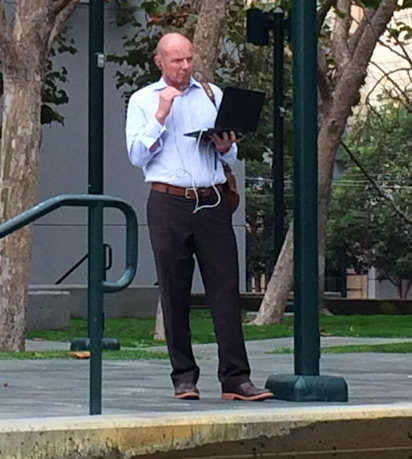
But as I watched the people around me, I couldn’t help but wonder if we’ve transferred more than just our data. All around me, people seemed buried in their phones or laptops.


Griping about people on their phones, though, is pointless. It’s our new reality. I run the risk of looking as stodgy as this church does next to its sleek corporate neighbors.
 
 
But a funny thing happened as I sat and watched. After a while, up through the babble of tech conversations, other sounds emerged.

The laughter of a young mom.


A rake in the grass.
The enthusiastic greeting of a man to a dog.
A bird behind me, feeding on seeds.


And the one word that was said to me, spoken by the groundskeeper in the hat who passed me when I picked up my paper that had blown to the ground: “Thanks.”
 
They were all little vignettes of everyday life. Anchored in the real world.


In a strange way, art is like the cloud. A painting represents a world of information accessible through a small interface. But rather than being just a storage of content, retrievable when we need it, art calls us to engage that world. And be changed by it.
Another park pressed with people!

I read recently a comment by Semir Zeki, a researcher in neuroaesthetics – a relatively new field of study of the effect of art on the brain. He observed, “The blood flow increased for a beautiful painting just as it increases when you look at someone you love.” Art challenges us to engage. It connects us with our common experiences.
 
It grounds us. 
 
Though it does require slowing down to engage with it, art helps us keep our eyes and hearts open to the world around us.
 
Even if our future looks very cloudy.

Sunday, October 25, 2015

Benched Week 90: and no cats were harmed


What are you curious about? 

On my way down to Drexel University this week in Philadelphia, I listened to a podcast of an interview with a successful author and entrepreneur. At one point he said that his earliest memory was one of being curious. He then said, “Curiosity is the essence of someone who solves problems.”


So I decided to give myself a problem while looking for a bench: what could I wonder about as I wandered?


Some things were easy. It’s hard not to be drawn by a large dragon sculpture -- and to mull over why it was there. (That answer came easily. Marco the Magnificent is the school mascot. And he’s everywhere.)


A dramatic fire escape made me consider if it was planned when the ornate building was constructed or added later.


But other ponderings called for more observation. What was this young woman studying so intently?


How could such a smartly-dressed man be so stupid as to smoke?


What brought these two women into the world of coeds?


Why is that one window different?


And who in their right mind would order anything from a truck with a cow like this on it?


All this questioning reminded me of something Denise Shekerjian, author of Uncommon Genius, wrote: “Noticing has a cousin: curiosity.” The latter flows out of the former. If one sits down long enough to notice the world around, questions naturally arise.
True inquisitiveness goes deeper. Honestly, none of these questions matter to me enough to find an answer. But even idle speculation has a purpose. It can lead to creating. If noticing asks “What is it?” and curiosity, “Why is it?” then creativity adds “What can it become?” The cigarette above might become a visual metaphor for rebellion in a painting. Or the start of a new genre of campus film noir.
So, in my search to rediscover my personal art, perhaps it’s as simple as seeing it as a quest for questions.
Now, isn’t that a curious thing?


Wednesday, October 14, 2015

Benched Week 89: thinking inside the box


I had been scribing for only a short time in my event this week when a familiar phrase popped up. “We need to think outside the box,” a participant reminded the large crowd. A little later, someone else suggested getting rid of the box altogether. Still later, another challenged everyone to “stand on the box!”

All the while, I was intently fixated on staying inside mine.


For this event, I had given myself the challenge of capturing content in “justified” columns – where all the lines ended at the same length, creating rectangles of words. Like articles in a newspaper.
It relied on intuition. I had to guess how large to make the initial letter of each line so that the words wouldn’t exceed my lightly ruled pencil box at the end. I didn’t do it perfectly, but close enough to make me happy.

Though there was no reason to add an extra layer of difficulty, I suppose I wanted to flex my typographical muscles a bit. Which is why, when I went looking for a bench in the expansive atrium of the resort later, I had to choose the one under the screen that called me out.


I had wanted to see what I could do in a confined space. Not unlike the Gaylord Palms hotel.

Granted, it had a much bigger space to work with. Under a high, glass dome, the hotel creators had fashioned an elaborate green space, replete with waterfalls...


...fake stone walls....


...even alligators.


It had as much authenticity as a fall pumpkin display in sunny Orlando, but I had to admire the creative effort. They almost transformed the inside of their box to feel like the outside.


We all have boxes. Some we create. Some are dictated to us. The question is: what can we do within them? One woman I talked with at the event told me how the first teacher to recognize her dyslexia told her she “had been given a great gift – a way of seeing things differently.” It’s the same perspective Malcolm Gladwell brings to dyslexia in his book David and Goliath. That teacher’s words (and the lifelong relationship they started) transformed the girl’s mental box as vibrantly as the gardens did the atrium. And a whole lot more authentically.
As the woman shared with me, I noticed her fingernails. There, in the smallest of canvases, an artist had found space to be creative.
Ultimately it’s not the size of the box that matters. It’s what we’re driven to do within that space.


Tuesday, September 22, 2015

Benched Week 88: the curious case of the rock-face door


Sherlock Holmes has been on my mind of late. (Hence the title.) Having recently finished The Great Detective, a fun read on everything Holmesian, I have been thinking often about mysteries. And curiosity. And the noticing of details.


But as I made my way to find a bench on Raspberry Island, in the middle of the Mississippi River with a view of St. Paul, I didn’t expect to find anything curious or mysterious, just perhaps something I could sketch out.

It was a sunny day, with a stiff breeze as I started across the bridge toward the island. Flags were snapping above me.


There’s not much on the island except some trails and a bandshell. But, thankfully, there was a bench with a great view of the city skyline.


As skylines go St. Paul’s is not spectacular. But the cliff on which it’s perched is rather unique.


And as I sat and took in the view, I noticed a singular detail (a nod to you, Arthur Conan!): a square doorway, cut into the rock face at a fairly inaccessible height. It begged questions: Why was it there? Did it open into a cave? What could be inside? Ever since my childhood, dark doorways have been like magnets to my imagination.

Dark doorways: an apt analogy for unresolved situations in life. We peer into them, hoping to get a glimpse what lies ahead, drawn by curiosity, held back by a vague sense of dread. There could be treasure waiting. Or a bear. Over this past weekend, I was re-reading one of my journals, wishing I could reach back and tell the me of twenty years ago what those dark doorways of the time led to.

Incredibly, as if on cue, a young man appeared at the top of the bluff and tossed over a rope. To my astonishment, he descended toward the hole, apparently as curious as I was.

Seriously, what are the chances I’d be here at this moment?


When he got to the doorway, he peered in for a moment then began his climb back up. The cave must have been disappointing. The only mystery that remained was whether his pants would make it to the top with him.


You know, maybe it’s one of God’s mercies that we can’t get a good look into our dark doorways, that we can't have a Sherlock surety about what lies ahead.  That me of two decades ago needed the ongoing unveiling in order to become the me of today.

The mystery is what makes the unfolding narrative interesting.

Tuesday, September 15, 2015

Benched Week 87: unicorns in the garden


I opened the solid, wooden door of Thurber House in Columbus, Ohio, and entered a little hesitantly. Expecting to find a docent hovering near the historical building’s entrance, I waited, feeling like I had intruded into someone’s home while they were napping upstairs. I wandered a bit, reading little displays. A bench in the living room beckoned, so I took a seat.


Overhead, muffled voice accompanied creaking floorboards. Perhaps James was getting up from that nap.


James Thurber (1894-1961) was a cartoonist, essayist, playwright and humorous author. Despite losing an eye in a childhood game of William Tell gone tragically wrong, he had a wry view on life. His work was steeped in satire, but a gentler sort than today’s sharpened swords of irony.


His cartoons have an odd looseness to them. His friend, Dorothy Parker, said they had a “semblance of unbaked cookies.” I like Thurber’s dogs, in particular. I find that my go-to drawing when I’m leaving notes in hotels or drawing for kids on planes is a something similar. There’s something disarming about a silly dog.


This one is mine.


He credited his mother for giving him his sense of humor. Years ago, while researching the childhoods of creative celebrities,  I discovered a delightful story about Mrs. Thurber.  One time, when dignified visitors had come to the house, she descended the stairs in her dressing gown, wild-eyed and hair disheveled, saying that she had just escaped from the attic, where she had been locked because of her profession of love for the postman!

There’s some serious playfulness at work there.


Outside, I found a shady side-yard, where two stone dogs kept me company. And across the street, a ring of bushes surrounded a statue of a unicorn, eating a lily. That image came from one of Thurber’s many fables, in which a husband tries to convince his wife that he has seen a unicorn in the garden.


It’s a nice analogy for Thurber’s created world – where the whimsical and the unexpected bump regularly up against every day life. (Just like with another of his creations, Walter Mitty.) And in my art, I strive to make the whimsical nibble at the edges of the world’s seriousness.


On my way back to the hotel, I passed under an imposing piece of sculpture at the Columbus College of Art and Design. But I’m happier thinking of ART in lower-case letters. Art as the unicorn in the garden.

Or a slightly goofy dog.

Tuesday, September 8, 2015

Benched Week 86: pears of wisdom


 Bill greeted me with a pear. I had come to turn one of our occasional chats at his farm into a bench-sitting, and the bench on his back porch was littered with the fruit he had just picked. So he offered me one.


More than that, he handed me the picker and said, “You’re tall. You should be able to reach the ones I couldn’t. Make yourself useful.” So for the first time in my life, I was plucking Bartlett pears off of branches and dodging the ones that volunteered to try to bean me.


Bill looks every bit the part of a Pennsylvania farmer. And so he was, growing up – that is, before he became the head of the Education department at Bucknell University, across town, as well as a nationally respected consultant. Farmer and professor: it’s as incongruous a combination as the peacock that roosts in one of his trees.


At 87, he’s still mentally sharp and active. As we sat down, I directed our conversation with a simple question: “To what do you attribute your long life?” Knowing Bill, I knew he’d answer me with stories. As with all of us, memories gather with the passing years like pigeons on a silo.


He answered simply: “My work ethic.” Then, closing his eyes – as he often does when remembering – he explained.

As a nine-year-old farm boy, he was milking cows two days a week, barely strong enough to carry the buckets of steaming milk back across the snowy field from the barn. And at age twelve, he was mowing fields of hay with a team of horses. His mother and he would haul it into the barn with hay forks. “I was exhausted beyond words,” he said. “But then she would get me a glass of cold buttermilk and we’d chat a while. And then she’d say – and I’ve never forgotten this – ‘Do you suppose, Bill, we could get one more load of hay in the barn?’”


Just one more load. That became a life motto for him. Just focus on doing one more thing. Then before you know it, you’ve done much more than you expected.

It’s an ethic that drives me, as well. I try to push the boundaries of what I can do. Go a little farther than expected. Give myself an extra challenge – whether that’s trying out pastel on foam core boards or adding one more event to an already full month.

But when is “one more load” one too many? Lately, I’ve been thinking more about the mixture of work and life, even turning down a few gigs to spend more time at home. It’s a question Bill has thought much about over his life as well. I shared with him some of my struggle with this. And he listened and answered with the insight and affection I appreciate so much in him.
It’s hard to get the balanced answer to life’s big questions -- without the wisdom of family and friends. And as Bill has taught me, those friendships are sweet.

As sweet as a hand-picked pear.